Titles are used to introduce a film, especially a film within the thriller genre. There are various examples within the thriller genre in which make themselves stand out from the crowd.
The first title sequence is of Se7en, in which had been directed by David Fincher, starring Morgan Freeman, Brad Pitt and Kevin Spacey. The way how the title sequence had been shown is within a chilling and dark atmosphere. The editing in which skewers the shots tries to give it the sense of, mystery with what the person is doing and what are his incentives behind all of this, giving it a sense an enigma that is happening within.
Showing posts with label Research. Show all posts
Showing posts with label Research. Show all posts
Wednesday, 1 April 2015

Thursday, 19 March 2015
Studio Idents
Studio idents are ways to introduce the film and the company that have made this. Over the course of time, they have evolved into brand new versions of the old intros, and then it have then stuck and had been a major part of the movies, any type and any director.
 One example of a ident is of the 20th Century Fox. It is an animated ident, in which it have started with the top view, and then it goes down towards the front, along with the lighting showing as if it is a very important event, in which case, the important event is the movie itself. The examples of films showing the ident from the company are films like the 'Aliens' trilogy and the 'X-men' series.
 Paramount Pictures is also involved in the big six producers of films, they were created in 1912, the mountain with the stars is one that many people know of. This prouction company are known to delve in different films, along with different genres, an example of a film in this producer is the known 'North by Northwest', which has been created by Alfred Hitchcock, a legendary director in the thriller genre of films.


Warner Brothers are also one of the most notable producers, with the crest being present with the initials of WB, The company was founded within 1923, their most notable films were of The Hobbit trilogy the Dark Knight trilogy, American Sniper and Man of Steel. They create films in varying genres, more in the superhero genre with Superman and Batman.
 Universal Studios is also another very known one, and one of the more notable studio idents, it starts of with the Earth, and then the Universal title starts to move towards the centre, aligning itself in the middle. Similar to Paramount, this production company was created in 1912, the most examples of their works are of E.T, Jurassic Park and Jaws.
Walt Disney Pictures is also another very known producer created in 1928, the ident shows the castle in full view, and then goes minimalist and presents the outline of it. They have done notable films such as The Lone Ranger, Pirates of the Carribean and Alice in Wonderland(2010).
One example of a ident is of the 20th Century Fox. It is an animated ident, in which it have started with the top view, and then it goes down towards the front, along with the lighting showing as if it is a very important event, in which case, the important event is the movie itself. The examples of films showing the ident from the company are films like the 'Aliens' trilogy and the 'X-men' series.Paramount Pictures is also involved in the big six producers of films, they were created in 1912, the mountain with the stars is one that many people know of. This prouction company are known to delve in different films, along with different genres, an example of a film in this producer is the known 'North by Northwest', which has been created by Alfred Hitchcock, a legendary director in the thriller genre of films.Warner Brothers are also one of the most notable producers, with the crest being present with the initials of WB, The company was founded within 1923, their most notable films were of The Hobbit trilogy the Dark Knight trilogy, American Sniper and Man of Steel. They create films in varying genres, more in the superhero genre with Superman and Batman.
Universal Studios is also another very known one, and one of the more notable studio idents, it starts of with the Earth, and then the Universal title starts to move towards the centre, aligning itself in the middle. Similar to Paramount, this production company was created in 1912, the most examples of their works are of E.T, Jurassic Park and Jaws.Walt Disney Pictures is also another very known producer created in 1928, the ident shows the castle in full view, and then goes minimalist and presents the outline of it. They have done notable films such as The Lone Ranger, Pirates of the Carribean and Alice in Wonderland(2010).
Styles of editing
There are various styles of editing incorporated to create some form of effect being shown, especially in the thriller genre.
Montage Theory: Russian filmmaker and film theorist Lev Kuleshov, created a theory, that a film is similar to a house, the shots represent the bricks, so each shot was the brick for the house, so in the end, the once all the shots(bricks) were done, that would make the film(house). Montages especially were different images/films combined together.
Fade: The fade cuts as the image/video darkens and/or brightens, for most cases throughout the film, it is use to convey a passing of time, in which is a common thing to use.
Continuity Edit: This edit tries to make it into a chronological order, even if it is a flash back, it will still make sure that the time is moving forwards, and not any other way.
Graphic Match: A match-cut or raccord is an effect in which there are two separate items, in two different regions, where those two shots of those, graphically match.
Match-on action: The said character starts an action, such as a fight sequence, and then we see this segment to the end.
Wipe: This transition is basically when one segment of the film clip, gets shifted in any direction, this is the transition in which gets recognised quicker by the audience, the most common wipe in which is conveyed is when it is wiped to the right, because it links to the fact that time is being passed.
Eye line match: What this does is essentially move the camera from the character to what the character is seeing.
Jump cut: The reason why the transition is often use is because it grabs the audience's attention, it is quick and sudden, not slow and predictable, it essentially breaks the continuity editing, the reason why it feels like it is because it looks like something from that scene was removed from it.
Straight/Normal Cut: The last and most common cut is the straight cut, it the editing in which is the most common out of all of them, it is used to retain reality within the film, they are slow, however, these edits does not distract the audience, it does not obscure the audience's attention.
The reason as to why I have done a blog on this is because I have now gotten used to the camera work, and had practiced editing within our couple of films that we have created, and I wanted to learn more examples of the various types of editing and how are they used in films, especially within the thriller genre.
Monday, 16 March 2015
Movie Theorists
There are various theorists involved within the film industry in which have created various theories, these theorists are: Barthes with the Enigma code, the Binary Opposition by Levi Strauss, the 3 Act of the Traditional Hollywood Structure, Todorov's Narrative Theory with the 5 stages and Propp's Character Types.
The first thing within the Hollywood Structure was very basic and traditional. It is mainly three parts/acts. The first segment is 25% of the movie in which is the set up of the movie, it is the primary premise of it, it sets up the characters, the story and some things in which are extremely crucial to the main story segment. It is strictly a linear plot, there is very often little to no sub plots involved within the main story. The main thing that is involved within the main story, is that there is often closure within these type of stories.
The next thing involved is Roland Barthes' Enigma Code, it is essentially the mystery within the story being connoted within it, there is the open code in which the story has no resolution within the end of the story, while closed is the opposite, the story has a resolution. Films or television shows such as Eastenders, do not have a resolution entirely, it would still develop over time.
The next theorist is of Levi Strauss, in which shows the Binary Opposites, via dominant and subordinate. The main examples are with the hero and villain, male and female. The main example can be of Good and Evil, in which in the popular example within the trilogy is of the Star Wars, in which Luke Skywalker is in the good side, or the Jedi, whereas Darth Vader(Anakin Skywalker) is in the bad side, or the Sith, Batman and Bane/Joker/Two Face.
The next theorist is of Todorov and his Theory on Narrative, there are essentially 5 stages to it, the first stage is of the equilibrium, as how it has started, then the next stage is the disruption of the equilibrium in which has been triggered by an event, then they recognise that the disruption has happened, there is then an attempt at repairing this disruption, and the final stage of it is the reconstruction or repair of the equilibrium. A very notable example of this is of the Die Hard, the 1988 action film staring Bruce Willis, the first stage is of John McClaine, with his wife, going to the Nakatomi Plaza on Christmas Eve for a party, the next stage is of the disruption of the party created by the terrorist, Hans Gruber, the police and John realise that everyone is kept hostage by Gruber and his terrorist group, in which the next stage is for John to become the one man army and to stop everyone including Gruber, in which he does, and the equilibrium has been restored.
Vladimir Propp's theory is of the various character types involved, in which he had incorporated and analysed teaditional folk stories and had found 8 different character roles in which are key to the story. The hero, villain, helper, donor(provider), father, dispatcher, the princess and the false hero, in which some of these characters can be in more than one role. Examples: Hero= Tony Stark(Iron Man), Villain=General Zod(Man of Steel), Helper=Short Round(Indiana Jones and The Temple of Doom), etc.
The other theory is of Laura Mulvey's Male Gaze, the theory is of the fact that women are seen as erotic pleasure, the women are passive and men are active in the movie, women do not move the plot forward, the cinema reflects patriarchal society. Films like Rope portray the olden times in which
Tuesday, 27 January 2015
Psycho

The way how the Macguffin within the movie is portrayed is essentially the money within the envelope, the $40,000 and the phone booth, these are normally ignored at first, just fully left out as they may not be important at first, but then within the near finale/climax of the movie, it will reappear.
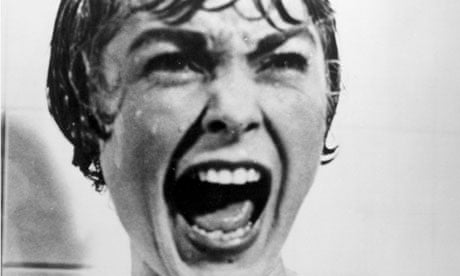
Along with the Macguffin, the definitive part of the movie is of course of the murder scene, as the main character eventually becomes murdered in the very infamous shower segment, this was one of the reason that the film had gartered some controversy, as this has not really been seen or developed normally, and that they would've required Hitchcock to redo or to remove the segment entirely, which he had said that he had removed it, but instead of abiding to them, he had still kept it and they did not fully realise.
The murder scene which had some forms of the murder scene had led to Paramount wanting this to be removed, however Hitchcock had stated that nobody had seen the actual stabbing, the fast cutting of the scene gives the illusion that we are seeing the stabbing of the main character, but not exactly showing it.
The suspense that the film had given was very crucial, it gave the feeling that the murderer may eventually strike again, but it could happen at any time, any place, stresses the apprehension, there is less and less violence than everyone seems to think. To avoid making the characters more cliche than they are normally, by deciding to make them flawed, with giving them mistakes and flaws within their own personality. The major elements of the movie however, were of shower murder scene and the final segment of the mother. What happen with the mother was her fate in which had been left over, which was the fact that she was dead, and that the murderer was disguised as her mother all along, and that he was covering up the fact that she was dead the whole time.
The thriller is more of a villain driven plot, in which the antagonist has confused the main protagonist and the people who were planning to stop him and to put him behind bars, however, he tries to up them by putting himself as a disguise as his own mother.

 The legacy that the film had left was shocking, as because of its new conventions of the thriller genre, had allowed it to create 3 sequels, in which however, started out as positive with the Psycho II, and then the acclaim dropped to mixed reviews with Psycho IV: The Beginning. There was also a 1998 remake of the film, however, it received negative reception as it had done nothing new to the remake, as it instead, done a shot-to-shot remake.
 Excluding the many sequels and the remake, it had also caused a cultural impact, as because of the murder scene and the conventions that it had used, it had easily become one of the most recognisable film, and it was considered to be Hitchcock's best movie, especially with the murder scene being one of the most notable scenes in movie history, the reason as to why is because of the Soviet montage style, in which had made it look like an actual murder has happened.
Tuesday, 20 January 2015
Unknown
Unknown
 Unknown is a 2011 psychological thriller directed by Jaume Collet-Serra, and starring Liam Neeson, Diane Kruger and various other actors. The film has generally been well recieved within the box office, getting over $136 million, being successful within its first week as a number 1 opening, it sold 13.9 million tickets in 29 countries. However, the reviews were met by critics as a mediocre to above average film with scores ranging from 2.5/25 to 9.0/90. The story starts off with Dr. Martin Harris(Liam Neeson) with his wife, Elizabeth 'Liz' Harris(Diane Kruger) arriving within Berlin, Germany to go on a visit for a biotechnological summit, however, once within the hotel that they are booked within, the main protagonist, Martin, realises that the bag/briefcase that he had was left behind in the taxi they were in, so in order to get his briefcase, he takes a taxi by a woman named Gina, however, they crash within the bridge, the crash eventually had led to a spiral for Martin Harris, when he arrives at the hotel, his wife claims that he does not know him, and that she is with another man, who claims is him, Dr Martin Harris. The protagonist has to find out who this person is, while avoiding people who want him dead.
The way how the film is portrayed is by the protagonist trying to figure out the issue in which is present, which is that a person is an imposter, impersonating him, so it gives a sense of mystery within the thriller being shown throughout. The original sense of equilibrium has been shattered, thanks to the issue in which is being shown within the film, as he has to find out what has happened and what has been the cause of all of this and why this has happened, and to eventually, confront the person/people who disrupted the equilibrium and to solve it, creating another equilibrium.
The way how women are portrayed are as either people who help out the main character and as a person who would be an assassin. Gina, who was the female taxi driver, had helped out the main character throughout the movie to try to piece the information together about what is going on. On the other hand, the other way that women were portrayed was as an assassin. Elizabeth Harris, was just an identity used in order to kill Prince Shada, it can be shown as her becoming a deceiver.
Unknown is a 2011 psychological thriller directed by Jaume Collet-Serra, and starring Liam Neeson, Diane Kruger and various other actors. The film has generally been well recieved within the box office, getting over $136 million, being successful within its first week as a number 1 opening, it sold 13.9 million tickets in 29 countries. However, the reviews were met by critics as a mediocre to above average film with scores ranging from 2.5/25 to 9.0/90. The story starts off with Dr. Martin Harris(Liam Neeson) with his wife, Elizabeth 'Liz' Harris(Diane Kruger) arriving within Berlin, Germany to go on a visit for a biotechnological summit, however, once within the hotel that they are booked within, the main protagonist, Martin, realises that the bag/briefcase that he had was left behind in the taxi they were in, so in order to get his briefcase, he takes a taxi by a woman named Gina, however, they crash within the bridge, the crash eventually had led to a spiral for Martin Harris, when he arrives at the hotel, his wife claims that he does not know him, and that she is with another man, who claims is him, Dr Martin Harris. The protagonist has to find out who this person is, while avoiding people who want him dead.The way how the film is portrayed is by the protagonist trying to figure out the issue in which is present, which is that a person is an imposter, impersonating him, so it gives a sense of mystery within the thriller being shown throughout. The original sense of equilibrium has been shattered, thanks to the issue in which is being shown within the film, as he has to find out what has happened and what has been the cause of all of this and why this has happened, and to eventually, confront the person/people who disrupted the equilibrium and to solve it, creating another equilibrium.
The way how women are portrayed are as either people who help out the main character and as a person who would be an assassin. Gina, who was the female taxi driver, had helped out the main character throughout the movie to try to piece the information together about what is going on. On the other hand, the other way that women were portrayed was as an assassin. Elizabeth Harris, was just an identity used in order to kill Prince Shada, it can be shown as her becoming a deceiver.
Tuesday, 13 January 2015
Rope (1948)

 It is a 1948 film in which was created by Alfred Hitchcock, it is essentially based upon the 1929 play in which is the same name, however, created by a different person by Patrick Hamilton and then had been adapted by Hume Cronyn and Arthur Laurents. The premise behind the play was essentially based upon the real life situation of the murder of Bobby Franks, a 15 year old by the people known as Richard Loeb and Nathan Leopold, who were from the University of Chicago in 1924.
It essentially begins with the murder of David Kently by two of his associates Brandon and Phillip, it is all in the movie where suspense is laying around, with what they would've wanted to create, which is the "perfect murder", eventually the more the movie develops, the more that each of the characters try to figure out David's disappearance, and eventually the killers will start to crack and within the plot, one of the people will have to reveal the whole incident and to put the two killers to rest and to arrest.
 The premise behind all of the stories from the movie and the play is of the theory of Supermen/Ubermensch, what the premise from the German/Prussian Friderich Nietzsche. What it essentially is, is that the person has this superiority complex and that because they are intelligent and in the higher level of society, he can be able to surpass the law and not get caught by the law, their own delusion of superiority had made them cause these said violence and crimes.
The characters in which are being shown within the set, mainly the two characters Brandon and Phillip, have been portrayed with a homosexual subtext, this is was a very controversial move to do to create it as a subtext within the 1940s, when they had to describe the homosexual context, they had to phrase it as "it", the reason why there was this context was because both the main actors Dall and Granger were both homosexuals in real life. The issue that many towns have had with it was that the minds of Leopold and Loeb was still fresh in their mind, so these towns had banned it independently.
Monday, 24 November 2014
North by Northwest (AS Media Studies)
The Trailer:
 The reason why the trailer/ film appeals to the audience is they way how it is developed, set up and what the critics have said, since it mainly contains a lot of positive statements about this movie, since if critics say positive things about the movie, then many people would be willing to watch the movie for the sense of having fun and to enjoy this film as a thriller to be excited with the plot twists, the intense action segment and the cliche, yet intriguing story that the director Alfred Hitchcock has created.
The Thriller Conventions of this movie:
There is tense music to set the atmosphere and how it is meant to be created into, the next convention that this movie has is the sense of enigmas, in which is the main mystery of the movie, the protagonist is trying to restore the equilibrium in which has been destroyed and ruined by the main antagonist who is trying to stop him, along with that, the antagonist at the beginning has no identity to go by, or he may go by a false alias to try to keep his true identity hidden from the protagonist trying to stop them. There are closeups involved, in order to focus on some props to aid the viewer watching the movie, and to also convey emotions within the dialogue, if the close up is used within that said dialogue that is being conveyed.
Is: “resourceful
heroes who
must thwart the plans of more powerful and better equipped villains.” true for North by Northwest?
In a way that it is being conveyed, it is true, due to the way that the antagonist is being portrayed, the antagonist is always a step or two ahead of the protagonist, in which case, yeah, however, it may be also false, due to the fact that they are more or less identically equipped. In which case, they may be identically equipped, in which have equal strength to collide with one another in the main showdown against one another, in which case, it all eventually leads up to the battle of the wits, who outsmarts who in the battle to the death against each other.
What theories apply to the film?
The Three Act Structure, it is a very typical Hollywood narrative, the set up, in which starts off the film, slowly, in a mild paced style, that is the first quarter of the film.. The Confrontation in which is the second and third quarter of the film, to try to show us who the main villain is and how does he do this to convey his sense of evil, and the final quarter is the climax, it is the last segment of the film, in which is the confrontation with the main character and the antagonist and the resolution.
The next segment is the Character Type in which Vladimir Propp had created, Cary Grant's character is the hero, Eve Marie Saint's character is the helper to Cary Grant and in a way, within the last segment, the princess, in which needs to be saved. James Mason's character is the villain, and Martin Landau as the villain's helper.
Todorov's theory is also incorporated, in the beginning there is a sense of equilibrium, some sort of balance being conveyed, in which case, Grant's main character is just in the city, working and is living a good life, then all of a sudden the disruption is being connoted, in which case, Mason's antagonist, sent a couple of his goons to take him away, and to take him to his place, in which he gets drunk and sent to his death by a car driving off the road, and letting him drown, then the police get involved. In which at a new segment, there is a new sense of acknowledgement that the main antagonist is causing havoc within the place or places that they are within and that they will need to try to find a way to stop them. Next is the resolution, in which they are going to stop the people in which are trying to create the disruption one way or another, and once they have found a resolution to the problem, then there is a sense of a new equilibrium, in which case the balance has been restore or in this case, re-created.
Barthes' theory of text being a complex bundle of meaning is mainly incorporated, in this case, there is a sense of resolution at the end, in which case, the text is a closed one.
Strauss' binary opposition has been incorporated, the hero and the villain, in which is Grant and Mason.
Tuesday, 11 November 2014
The Birds
The Birds is a 1963 thriller created by Alfred Hitchcock, in which it was loosely based on the book with the same title by Daphne du Maurier, in which was created in 1952. This was a debut for Tippi Hedren, along with that, it is also starred by Rod Taylor, Jessica Tandy, Suzanne Pleshette and Veronica Cartwright. What Hitchcock would've wanted from the film was to develop brand new characters from the original book and to also keep the unexpected bird attacks in the movie. It is a MacGuffin, it mainly helps the story progresses, it is a major plot device, it conveys little to no narrative needed to explain it.
The main external threat of the whole movie is nature, mainly, about birds, animals in which look like they have been tormented for far too long and that they have wanted to get their revenge on people who would've wanted to kill them and use them or consume them. In the main segment, there is nowhere to hide, no matter where you are, they can come from anywhere, from the chimney, the windows.
There are fast paced segments within the film, such as when the students are running away from the birds, as it conveys that the students are running way from that certain danger in which may hurt them in the process. Another segment is when they are trying to defend their home from the birds once they are holed in their own home, it is a very frantic scene to try to block off every single pathway to avoid the birds from entering the home and endangering their own lives.
Wednesday, 10 September 2014
Genre
What is a genre?
A genre is essentially a category for films in which would mainly depend on the content that is has altogether.
Examples of Genres: Crime, Action, Thriller, Sci-Fi. Horror, Comedy, Romance, Drama and Fantasy.
How to categorise a film in a genre: As explained, this is mainly dependent on the content that the film has, if the film has more lighter tones in which can make people laugh, it is a Comedy, if the content is that the film has a setting within the near or far future, if it uses advanced technology or science, then it is a Sci-Fi, if is has a scary and tense atmosphere, suspenseful music, then it is classified into Horror.
Films in their genre: Crime- Pulp Fiction, Scarface, The Godfather, Sin City, The Wolf of Wall Street.
Action- Kick Ass, Guardians of the Galaxy, Sucker Punch, The Avengers.
Thriller- Before I Go To Sleep, The Dark Knight, Se7en.
Sci-Fi- Total Recall, Star Trek: Into Darkness, Star Wars.
Horror- Aliens, Nightmare on Elm Street, Evil Dead, Friday the 13th.
Comedy-Monty Python and the Holy Grail, Anchorman, Shawn of the Dead, Scott Pilgrim VS the World, American Psycho.
Romance-Her, The Fault in our Stars, Titanic, Forest Gump.
Fantasy- The Lord of the Rings, The Hobbit, Jumanji.
Subscribe to:
Posts (Atom)