Tuesday, 27 January 2015

Psycho

Psycho is a 1960 psychotic-thriller in which has been created by Alfred Hitchcock and had been published by Paramount Productions, in which stars Anthony Perkins, Vera Miles, John Gavin and much more. This film has been considered by many as one of the best thrillers and one of the best movies of its time and of all time, and also is one of Hitchcock's best movie ever created, this movie has also created the new level of acceptability with the way how violence is portrayed and the behaviour of the characters within movies.

The way how the Macguffin within the movie is portrayed is essentially the money within the envelope, the $40,000 and the phone booth, these are normally ignored at first, just fully left out as they may not be important at first, but then within the near finale/climax of the movie, it will reappear.

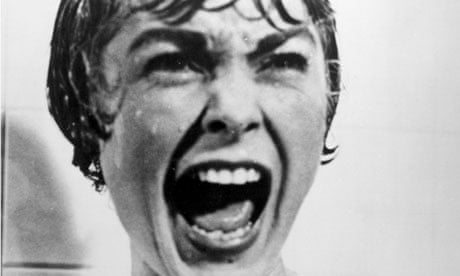
Along with the Macguffin, the definitive part of the movie is of course of the murder scene, as the main character eventually becomes murdered in the very infamous shower segment, this was one of the reason that the film had gartered some controversy, as this has not really been seen or developed normally, and that they would've required Hitchcock to redo or to remove the segment entirely, which he had said that he had removed it, but instead of abiding to them, he had still kept it and they did not fully realise.

The murder scene which had some forms of the murder scene had led to Paramount wanting this to be removed, however Hitchcock had stated that nobody had seen the actual stabbing, the fast cutting of the scene gives the illusion that we are seeing the stabbing of the main character, but not exactly showing it.

The suspense that the film had given was very crucial, it gave the feeling that the murderer may eventually strike again, but it could happen at any time, any place, stresses the apprehension, there is less and less violence than everyone seems to think. To avoid making the characters more cliche than they are normally, by deciding to make them flawed, with giving them mistakes and flaws within their own personality. The major elements of the movie however, were of shower murder scene and the final segment of the mother. What happen with the mother was her fate in which had been left over, which was the fact that she was dead, and that the murderer was disguised as her mother all along, and that he was covering up the fact that she was dead the whole time.

The thriller is more of a villain driven plot, in which the antagonist has confused the main protagonist and the people who were planning to stop him and to put him behind bars, however, he tries to up them by putting himself as a disguise as his own mother.


The legacy that the film had left was shocking, as because of its new conventions of the thriller genre, had allowed it to create 3 sequels, in which however, started out as positive with the Psycho II, and then the acclaim dropped to mixed reviews with Psycho IV: The Beginning. There was also a 1998 remake of the film, however, it received negative reception as it had done nothing new to the remake, as it instead, done a shot-to-shot remake.


Excluding the many sequels and the remake, it had also caused a cultural impact, as because of the murder scene and the conventions that it had used, it had easily become one of the most recognisable film, and it was considered to be Hitchcock's best movie, especially with the murder scene being one of the most notable scenes in movie history, the reason as to why is because of the Soviet montage style, in which had made it look like an actual murder has happened.


Thursday, 22 January 2015

Past Student Work

What we have seen is a set of student's media work, in which there were 5 examples which were present, a couple which were interesting, and one or two which were just poor in which each flaw made it a huge issue.

Hidden:
is a student film in which had more issues than expected. The music choice was good, helped out with making it a thriller-esque film, and unfortunately, that was it. The transition within the film is very awkward, and the timing in which is filmed in is not very good, it was way too dark, some of the characters are not visible. The movie cuts involved were pretty average, some good cuts were involved, whereas others were very choppy, there was a sense of forms of continuity errors, which made the intro pretty odd. The acting ranged from mediocre, all the way to poor, there was a bit too much dialogue, and the execution was not good, it made it feel awkward. The zooming shots involved within the movie did not even help at all, it actually made things a bit more worse. The setting wasn't even that good, an average street in Dagenham, it made things feel much more generic. Out of 5, I would give it a 2.          

Power Cut:


The premise of the film is strong and unique, the opening for the the intro was very strong, intriguing, however, over the course of several seconds later, it becomes very repetitive and would eventually become very stale. The music in which has been used, gives it a very strong approach to the film, but the cutting of the movies was mediocre, some were not properly cut. The Neo-Noir feel to the movie with the greyscale gives the strong effect within the movie, but the zoom within the movie was very awful, that it was part of the major reason that the movie was not that fully good, it had potential.There was a segment of the dialogue in which was not fully recorded, made the segment pretty off, and the setting once again was pretty questionable, and may have been a different setting to make it more effective. The overall score is the same, 2/5.

Hunter: The work was interesting, better than the others, but it still had issues. At first, it had some pretty choppy editing, on the other hand, there was some dialogue present, even though it was on the average side. The music is done correctly, it sets the tone very accurately, giving it a strong perspective, the clothing is also another strong field, it gives it a more accurate detective feel to it, setting too make sense, even though at the beginning of the film, it kind of feels a little bit confusing as to why. The cutting may have needed to be a little bit faster, the continuity of the film may have been a little bit broken, a more over the shoulder perspective/shot would've improved it. Excluding the dialogue cut, the editing of the film was effective, however, that been said, the focus of the film should've been a bit more clearer. In the end, I will give it a 3/4.

After eight: With this thriller opening, it was a very strong example, suspense was very effective, giving it a stronger feel to the film, but the rain effect at the beginning was very weird, however, but the lighting of the film was very good, the camera work was very solid, done with minimal problems. The flow of the acting was the best out of all of them, thought out with very good intention, even though there was not much of it, it was not very awkward, the cutting of the opening was good, the use of music compliments the work very well, however, the end of it can be a hit or miss depending on who is watching it. This opening gets a 3-4/4.

The Catalyst: The theme of it was interesting, the espionage/assassin of it is a very slick feel to it, the strong music choice once again compliments the film and gives it a more interesting layer to it. However, one issue in which I had was the sniper scope/aim, it did not feel very realistic, it may feel like a gripe, because it does not fully deter the film. The acting was essentially very average, it did not fully stand out, the henchmen involved did not give the film a stronger perspective, while the acting is average, the action was very effective. The cutting had some awkward mishaps, some not in sync segments made it a bit off, like the breathing segment, could've been more in sync. This got a 3/4.

There were some strong examples of how the past works made it right, the strong examples were The Catalyst, After Eight and Hunter. These films were very good examples either because of their strong choice of music, their editing and cutting skills, the shots and angles that they have places within, and various other examples. Whereas the others like Hidden and Power Cut did not fully succeed, either because of the poor lighting choice, the acting may have not have been executed properly, the shots may not have been as intended, and/or that the continuity may have been broken.


Tuesday, 20 January 2015

Unknown

Unknown

Unknown is a 2011 psychological thriller directed by Jaume Collet-Serra, and starring Liam Neeson, Diane Kruger and various other actors. The film has generally been well recieved within the box office, getting over $136 million, being successful within its first week as a number 1 opening, it sold 13.9 million tickets in 29 countries. However, the reviews were met by critics as a mediocre to above average film with scores ranging from 2.5/25 to 9.0/90. The story starts off with Dr. Martin Harris(Liam Neeson) with his wife, Elizabeth 'Liz' Harris(Diane Kruger) arriving within Berlin, Germany to go on a visit for a biotechnological summit, however, once within the hotel that they are booked within, the main protagonist, Martin, realises that the bag/briefcase that he had was left behind in the taxi they were in, so in order to get his briefcase, he takes a taxi by a woman named Gina, however, they crash within the bridge, the crash eventually had led to a spiral for Martin Harris, when he arrives at the hotel, his wife claims that he does not know him, and that she is with another man, who claims is him, Dr Martin Harris. The protagonist has to find out who this person is, while avoiding people who want him dead.

The way how the film is portrayed is by the protagonist trying to figure out the issue in which is present, which is that a person is an imposter, impersonating him, so it gives a sense of mystery within the thriller being shown throughout. The original sense of equilibrium has been shattered, thanks to the issue in which is being shown within the film, as he has to find out what has happened and what has been the cause of all of this and why this has happened, and to eventually, confront the person/people who disrupted the equilibrium and to solve it, creating another equilibrium.

The way how women are portrayed are as either people who help out the main character and as a person who would be an assassin. Gina, who was the female taxi driver, had helped out the main character throughout the movie to try to piece the information together about what is going on. On the other hand, the other way that women were portrayed was as an assassin. Elizabeth Harris, was just an identity used in order to kill Prince Shada, it can be shown as her becoming a deceiver.

Tuesday, 13 January 2015

Rope (1948)

It is a 1948 film in which was created by Alfred Hitchcock, it is essentially based upon the 1929 play in which is the same name, however, created by a different person by Patrick Hamilton and then had been adapted by Hume Cronyn and Arthur Laurents. The premise behind the play was essentially based upon the real life situation of the murder of Bobby Franks, a 15 year old by the people known as Richard Loeb and Nathan Leopold, who were from the University of Chicago in 1924.

It essentially begins with the murder of David Kently by two of his associates Brandon and Phillip, it is all in the movie where suspense is laying around, with what they would've wanted to create, which is the "perfect murder", eventually the more the movie develops, the more that each of the characters try to figure out David's disappearance, and eventually the killers will start to crack and within the plot, one of the people will have to reveal the whole incident and to put the two killers to rest and to arrest.

The premise behind all of the stories from the movie and the play is of the theory of Supermen/Ubermensch, what the premise from the German/Prussian Friderich Nietzsche. What it essentially is, is that the person has this superiority complex and that because they are intelligent and in the higher level of society, he can be able to surpass the law and not get caught by the law, their own delusion of superiority had made them cause these said violence and crimes.

The characters in which are being shown within the set, mainly the two characters Brandon and Phillip, have been portrayed with a homosexual subtext, this is was a very controversial move to do to create it as a subtext within the 1940s, when they had to describe the homosexual context, they had to phrase it as "it", the reason why there was this context was because both the main actors Dall and Granger were both homosexuals in real life. The issue that many towns have had with it was that the minds of Leopold and Loeb was still fresh in their mind, so these towns had banned it independently.